
Upgrading Your Hardware: Practical Ways Door Handles and D-Pulls Enhance Functionality and Style
Pull handles offer a practical, stylish hardware solution for everything from residential front doors to commercial entrances. Due to their oversized, easy-to-grip designs, pull door handles are often preferred over smaller knobs and levers. They provide excellent mechanical simplicity, effortless access, and clean, minimalist lines that bring a sleek, modern aesthetic to any setting.
The D-pull door handle is the most widely used pull handle across residential, commercial, and industrial settings. Named for its classic “D” shape, the design features a central, parallel grip connected to two distinct feet that mount directly to the door surface.
Unlike more ornate hardware, its minimalist design offers ample clearance for a secure, natural grip. This makes durable D pull handles both an excellent solution for accessibility and an easy upgrade for understated style.
Key Characteristics and Benefits
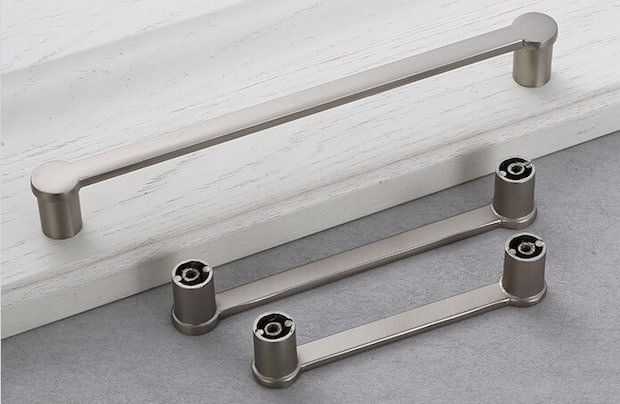
D-pull door handles offer multiple benefits over traditional lever handles, knobs and older pull-bar designs, particularly on doors that do not need a rotating latching mechanism to stay closed:
- Substantial and ergonomic grip: The handle’s enclosed shape allows users to grip the handle from the inside of the curve, providing a natural, instinctive motion that distributes pulling force comfortably across the hand.
- Accessibility: The closed-loop design makes the handles very easy to use, especially in households with children, older family members and people with limited hand strength and dexterity.
- Balanced aesthetics: Compared to the sharp lines in traditional straight bar handles, or oversized heavy knobs, the rounded ends of a D-pull handle balance both contemporary and traditional designs. This ensures versatility across multiple settings and door types.
- No latching mechanism: Like all pull-handles, D-pull variants do not turn or operate an internal latch directly. This means doors use alternative methods, such as roller bolt catches, deadbolts, overhead arms or magnetic catches to stay shut. The handle serves purely as a rigid grip to manually push or pull the door open or closed.
Where are D-pull Door Handles Used?
D-pull handles are highly versatile hardware staples used across diverse environments. They are ideal for high-traffic entryways, commercial spaces, and modern residential interiors, and are seen on sliding barn doors, pocket doors, heavy glass storefront doors, and sleek kitchen cabinetry.
In residential settings, they are perfect for pantries, utility rooms, and contemporary kitchens, providing an easy-to-grip surface. In commercial offices or retail spaces, they are paired with heavy timber or metal fire doors. Their clean lines complement minimalist, industrial, and transitional designs, offering reliable functionality on both interior passage doors and exterior entryways.
Materials and Finishes
Manufacturers craft D-pull door handles from various robust materials to match modern or traditional interior schemes:
- Grade 316 Stainless Steel: Unmatched in durability, 316 stainless steel resists corrosion, rust and heavy wear, making it the ideal choice for high-traffic entryways and exterior doors.
- Grade 304 Stainless Steel: A more affordable alternative to 316, this is a preferred material for high tensile strength and corrosion resistance. However, its lower molybdenum content makes it unsuitable for hot and humid coastal climates.
- Nylon (polyamide): Balancing low weight, high impact corrosion resistance and thermal and electrical resistance, Nylon d-pull door handles are the preferred door hardware in lighter doors, cabinet frames, and electrical panels. The material is made for the touch, does not require specialised coatings or paint and is recyclable.
- Solid Brass: A premium choice for high-end residential projects. Brass naturally resists corrosion and offers a weightier, luxury feel. However, uncoated brass will develop a living patina over time when exposed to the elements.
- Anodised Aluminium: With superior hardness, scratch and corrosion resistance, anodised aluminium D-pull handles are the durable, lightweight and affordable alternative to stainless steel. Common uses are high-traffic glass and aluminium-frame entrance doors, residential sliding and partition doors, and as standard hardware on fire-rated and emergency doors.
Finishes in D-pull handles dictate visual impact and maintenance needs. Choose handles in brushed or satin stainless steel to prevent scratches, flaking and staining, or polished stainless steel for a reflective, mirror-like shine, albeit one prone to fingerprints and smudges. PVD coatings work well on brass and aluminium, creating an additional scratch-resistant surface layer that also withstands UV and exposure to external contaminants. Nylon handles can be optioned in smooth, matte or glossy finishes, as well as a range of standardised RAL colours.
Buying Considerations
Fixing Types
How the handle attaches to the door affects functionality and security. Choose handles with back-to-back fixings, with two identical handles mounted directly opposite each other on either side of the door and connected by a bolt for residential entry doors and commercial entryways. These provide clean, symmetrical lines, equal pulling and pushing leverage and exceptional strength and durability. Alternatively, bolt-through fixings when mounting single handles, or concealed face fixings (with handles screwed directly into the face of the door from the outside, no visible internal fixings) for lighter doors and cabinets where pull strength is not a priority.
Compliance
For Australian usage, ensure doors and handles comply with Australian Standards AS 1428.1 for access and mobility. Compliant handles must have a minimum diameter of 15mm and a clear space behind the grip of 45mm to 50mm. This prevents hands from getting trapped and allows easy operation for all users.

