
Ideas for Starting a Diecast Car Collection: Understanding Scales
Scale is one of the first things many collectors consider when choosing a diecast car to add to their collection, along with the make, model and era. It determines the model’s size and how it will fit into their display space.
Although many different scales are available, the most popular sizes are 1:12, 1:18, 1:43, 1:64, and 1:32 scale model cars. The simplest way to understand scales is that the larger the number, the smaller the model. Having a variety of sizes in your diecast collection is common, so let’s look at what each size means for your display.
1:32 Scale
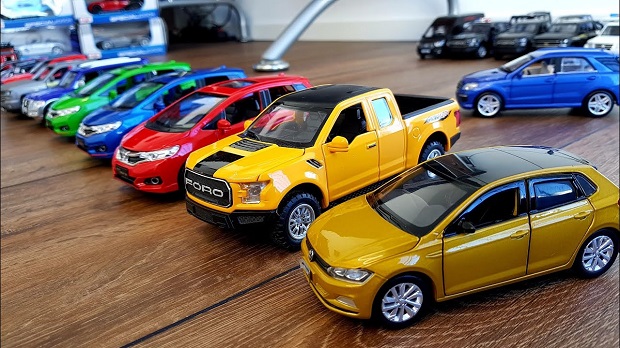
The 1:32 diecast cars are approximately 1/32 the size of the real vehicle. For a typical 4.5 m-long car, that works out at around 14 cm long, although the exact dimensions vary depending on the vehicle. This makes 1 32 scale diecast cars a good middle ground for collectors who want a detailed model that doesn’t take up too much display space.
Compared with 1:18 models, 1 32 scale cars are noticeably smaller and easier to fit on a shelf, while they have a stronger visual presence than smaller 1:43 and 1:64 models.
Next, they’re also generally easier to display as a group without needing a large cabinet. Depending on the brand, 1:32 models can feature details such as interior finishes, badges, wheels and opening parts, although the level of detail varies.
If you’re collecting classic cars, you could consider the 1:32 size for models such as the Ford Mustang, Volkswagen Beetle and Porsche 911. These cars have recognisable shapes and details that still come through at this size.
It’s also a handy scale if you want to collect several cars from the same era without filling your whole shelf with larger models.
1:18 Scale
At 1:18 scale, a diecast car is approximately 1/18 the size of the real vehicle. Using the same 4.5 m car as an example, the model would be around 25 cm long. That makes a 1:18 model considerably larger than a 1:32 car, so you’ll need more shelf or cabinet space to display it.
This size gives manufacturers more room to reproduce small features. Depending on the model, you may find detailed interiors, engine bays, working steering, opening doors, bonnet and boot, realistic wheels and carefully reproduced exterior trim.
The trade-off is usually price. Larger models require more material and can involve more intricate detailing, so 1:18 models are often more expensive than comparable smaller-scale versions, although prices vary significantly between manufacturers.
This scale suits collectors who want certain cars to become standout pieces in their collection, like iconic classics, limited editions, supercars and historically significant vehicles where you want to appreciate the design up close.
If you’re collecting cars from a particular manufacturer or era, a few carefully chosen 1:18 models can create a striking centrepiece rather than filling an entire shelf.
1:43 Scale
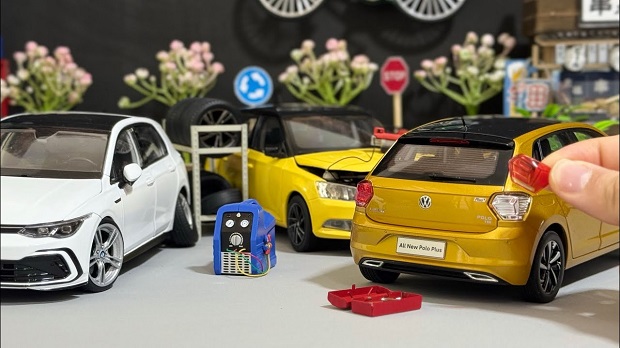
A 1:43 diecast car is approximately 1/43 the size of the original vehicle. A 4.5 m-long car would therefore measure roughly 10.5 cm in model form. Compared with a 1:32 model, it’s smaller and takes up less room, making it easier to display several vehicles together.
The smaller dimensions mean some details won’t be as prominent as they are on a 1:32 or 1:18 model. However, a well-made 1:43 model can still reproduce the car’s body shape, paintwork, wheels, lights, interior and other distinctive features.
The smaller size also makes this scale practical for collectors who want to build a large and varied collection but don’t have a large display cabinet.
Price can be another advantage. While premium 1:43 models can still be expensive, the scale is often more affordable than larger models.
Because 1:43 models take up relatively little space, this scale can work especially well for collecting a particular era, manufacturer, racing series or range of models. You could display several generations of the same car side by side or build a collection of classic European cars.
1:64 Scale
At 1:64 scale, the model is approximately 1/64 the size of the real vehicle. A typical 4.5 m car would be around 7 cm long, so it’s less than half the length of a 1:32 model. This compact size is one of its biggest advantages. You can fit many 1:64 cars into the space that would hold only a few larger models.
Because the models are smaller, manufacturers have less room for fine detailing. You may see simplified interiors, wheels and exterior features compared with larger scales.
However, modern 1:64 diecast cars can still capture the key styling cues of the original vehicle, and higher-end models can include surprisingly precise details for their size.
They are also often among the more affordable diecast options, making the scale accessible to collectors who want to build a sizeable collection without spending as much per vehicle.
The scale is suited to collectors interested in variety. You might collect everyday road cars, classic vehicles, emergency vehicles, race cars or different makes and models from a particular decade. It also works well when you want to create a miniature scene or display multiple cars together.

